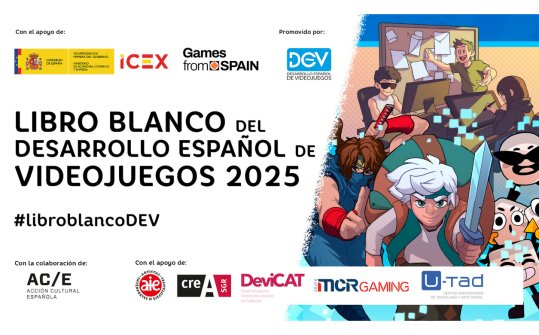
The twelfth edition of the White Book of the Spanish Video Game Development Industry reveals sustained growth in both revenue and female employment, though companies stress the urgent need for tax incentives to overcome the global investment slowdown.
Madrid, 07/07/2026
Spain's interactive entertainment sector remains robust and continues to demonstrate its strategic role within the digital economy. Yesterday, Monday, July 6, the twelfth edition of the 2025 White Book of the Spanish Video Game Development Industry was officially presented at the ICEX headquarters. The report was prepared by DEV (the Spanish Association of Video Game and Entertainment Software Development Companies). Both the full report and the executive summary are available for download on their official website.
The macroeconomic figures ratify an upward trend: the Spanish industry generated €1.464 billion (a 2.7% increase compared to the previous year) and reached 10,508 direct jobs (a 2.4% increase). A particularly positive metric is female employment, which climbed to 27%—positioning itself one percentage point higher than the prior period and outperforming the European average.
The census of active studios in Spain stands at 820 (with 500 legally incorporated as companies and 320 in the project phase). The geographical distribution remains heavily concentrated within four autonomous communities:
Catalonia: Solidifies its position as the undisputed driver, accounting for 54% of total revenue, 51% of employment, and 31.3% of active studios.
Community of Madrid: Holds the second spot with 25.6% of studios.
Andalusia: Maintains third place with 11.5%.
Valencian Community: Rounds out the primary group with 11%.
Despite structural fragmentation—where 56% of micro-companies register annual revenues under €200,000, while an exclusive 1% of large studios generate 55% of total income—the industrial fabric shows clear signs of maturity. For the first time, companies with over 10 years of experience form the largest demographic, reaching 37%.
The presentation featured a roundtable discussion moderated by Antonio Santo, where developers and executives analyzed the industry's current crossroads amid a global deceleration of capital investment.
Mauricio García, Director of The Game Kitchen and President of DEV, emphasized strategic adaptations: "We have to rethink our strategies: there will be an impact on the types of games we create [...] and co-developments with other studios will need to be considered as a way to mitigate uncertainty." On the other hand, Luis Oliván (Fictiorama Studios) and Katy Sánchez (Gameloft Barcelona) pointed out that robust sectors in other nations always benefit from direct institutional backing, arguing that tax incentives would inject the necessary capital to help independent studios scale into medium or large enterprises.
The institutional and political sphere was represented by figures such as Pablo Conde (ICEX), Juan Melgar (Ministry of Culture)—who defined video games as a "strategic and symbolic industry due to its creation of modern myths"—and Carla Redondo (Secretary of Digitalization), who highlighted the sector's vast social footprint: Spain currently counts over 22 million players.
This year's White Book sheds light on highly topical debates within the ecosystem:
Generative AI Utilization: 53% of studios already implement generative AI tools in their daily workflows (predominantly in programming and pre-production phases). However, significant caution remains: 46% of companies evaluate its impact as negative, no single department exhibits "high" confidence in the technology, and 16% explicitly prohibit it within their internal policies.
Viability Diagnosis: While the impact of the post-pandemic crisis has lessened slightly (53% claim to be unaffected), financial vulnerability persists: 52% of studios state that their viability will be at risk if the current investment drought extends for another year.
To secure projections heading into 2028—when the sector is expected to surpass €1.65 billion in revenue and approach 14,000 workers—DEV has once again presented public administrations with a package of urgent measures:
Tax Incentives: Amend the Corporate Tax Law to equate video games with the audiovisual sector, attracting both general and international capital.
Stable Public Subsidies: Consolidate multi-year financial aid plans that cover all development phases, specifically targeting pre-production and marketing.
National Investment Ecosystem: Reduce dependence on foreign publishers to ensure intellectual property (IP) is retained within Spain.
Talent Development: Facilitate the integration of junior profiles and align educational programs with real corporate demands, mitigating current hiring bottlenecks for technical programming roles.
Download the Report: The 2025 White Book of the Spanish Video Game Development Industry and its executive summary are available free of charge on the association's official portal: https://dev.org.es/libro-blanco-2025/.
This website uses cookies
Cookies are small text files that websites can use to make a user's experience more efficient. The law states that we can store cookies on your device if they are strictly necessary for the operation of this website. For all other types of cookies, we need your permission. This website uses different types of cookies. Some cookies are placed by third-party services that appear on our pages. You can change or withdraw your consent at any time from the Cookie Declaration on our website. Learn more about who we are, how you can contact us, and how we process personal data in our Privacy Policy.
Necessary cookies help make a website usable by enabling basic functions like page navigation and access to secure areas of the website. The website cannot function properly without these cookies.
| Name | Provider | Purpose | Expidation | Type |
|---|---|---|---|---|
| PHPSESSID | This website | Cookies generated by PHP-based applications. This is a general-purpose identifier used to maintain user session variables. It is usually a randomly generated number; how it is used can be site-specific, but a good example is maintaining a logged-in user's state between pages. | Session | HTTP |
| Language | This website | Language in which the website text is displayed. | 4 months | HTTP |
| consentcookies_Esenciales | This website | This cookie is used to store consent preferences | 1 year | HTTP |
| consentcookies_Preferencias | This website | This cookie is used to store consent preferences | 1 year | HTTP |
| consentcookies_Estadisticas | This website | This cookie is used to store consent preferences | 1 year | HTTP |
| consentcookies_Marketing | This website | This cookie is used to store consent preferences | 1 year | HTTP |